
Rehan Mazid
Founder, Policy Analyst, Speaker
Rehan Mazid is a policy analyst, speaker, and the founder of the Civic Clarity Foundation. He specializes in deconstructing policy issues and holding the government to account through analysis and public dialogue.With a focus on good governance and consensus building, Rehan convened the landmark "Youth Mental Health & The Role of Good Governance" panel. This rare cross-partisan initiative brought together sitting Members of Parliament (MPs) and Provincial Parliament (MPPs) from the Liberal, Conservative, and Green parties to find common ground.Following this success, the Civic Clarity Foundation released its official After-Report and Blueprint for Action, a framework distributed to Canadian Senators, MPs, and the House of Commons Standing Committee on Health (HESA).His policy work has attracted attention in Ottawa; notably, the Civic Clarity Foundation was encouraged by the Chair of the Standing Senate Committee on Social Affairs, Science, and Technology to submit a formal brief regarding the Chair’s bill for a National Strategy for Children and Youth.Rehan has appeared on CBC-KW’s The Morning Edition and joined 570 News Radio’s The Mike Farwell Show to discuss the Foundation’s work and their brief on the national strategy.Rehan continues to lead efforts in Waterloo Region and across Canada, proving that effective dialogue and strong policy analysis are the keys to tackling the country’s challenges.
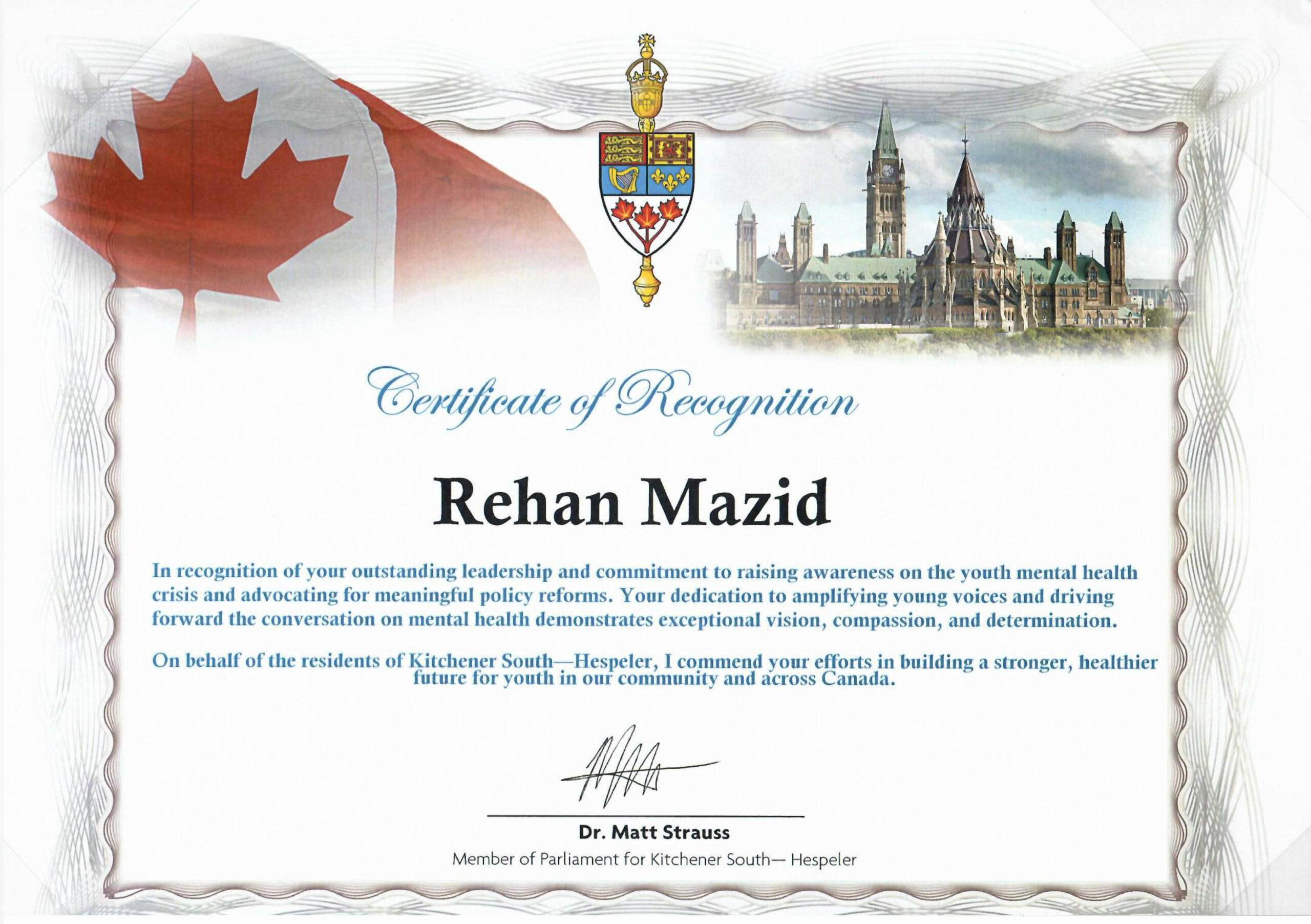
Certificate of Recognition
Certificate of Recognition from MP Matt. Strauss on August 29th, 2025.
Committments
Civic Clarity Foundation | Executive Director
Senator Marilou McPhedran's Youth Council | Member
City of Cambridge Youth Council | Member
Ontario Young Liberal Kitchener South - Hespeler | Member
Speaking Event
Democracy In Action WR - Launch Event
September 17, 2025
In a recent address to Democracy in Action, Rehan confronted the rising threat of hyper-partisanship. Rehan emphasizes partisanship as a natural and healthy part of our democracy but states much of the current political climate can be summed up by the rise of hyper-partisanship, diagnosing it as a destructive force eroding democratic institutions and public safety in Canada and abroad. Citing increasing threats against political figures, he made the case that prioritizing "party colors" over people stifles progress and disenfranchises citizens.He positioned the Civic Clarity Foundation as an essential antidote: an organization made up of diverse viewpoints dedicated to equipping the public with clear, evidence-based policy analysis. He highlighted the Foundation's work in action, including the release of detailed policy briefs on crucial legislation like Bill 5 and the federal Bill C-5.Central to his address was the Foundation’s recent panel on the youth mental health crisis. This landmark, cross-jurisdictional discussion successfully convened federal Members of Parliament, a Member of Provincial Parliament, and a Regional Councillor to find common ground on proactive, community-based solutions. The event serves as a powerful proof-of-concept for the Foundation's model: building consensus on complex issues by prioritizing collaborative dialogue.
Youth Mental Health & The Role of Good Governance
Moderating the Civic Clarity Foundation Panel
August 29, 2025
In response to the escalating youth mental health crisis across Ontario and Canada, the Civic Clarity Foundation convened the landmark "Youth Mental Health & The Role of Good Governance" panel on August 29th, 2025. This panel generated a cross-jurisdictional and cross-partisan consensus on one of the most critical issues of our time.The event successfully brought together sitting legislators from the House of Commons, the Ontario Legislature, and Waterloo Regional Council, representing the Conservative, Liberal, and Ontario Green parties. The explicit goal was to find policy-based solutions through common consenus.The panel's discussion yielded a rare and powerful consensus, crystallizing around three foundational pillars for effective governance:1. A Mandate for Genuine Accountability: A unanimous agreement that the "status quo" of consultation is a failure. The new standard must be a proactive, data-driven, and youth-led oversight process, empowering the voices of those most affected by the policies being enacted.2. A Shift from "Mental Healthcare" to "Mental Health": Panelists from all parties concurred that treating mental health solely through a clinical, crisis-response lens is a strategic dead end. They identified the root drivers of the crisis as systemic issues, including the housing crisis, food insecurity, poverty, and a lack of community connection.3. The Imperative of Community-Driven Solutions: The discussion firmly rejected top-down, centralized government programs as the primary solution. Instead, a consensus emerged around a new model where the role of government is to fund and empower the proven, grassroots, and often youth-led initiatives already developing solutions from the ground up.The outcome of this panel is not merely a summary; it is a Blueprint for Action. It serves as a powerful proof-of-concept for the Civic Clarity Foundation's core thesis: it is possible to build consensus on complex issues by prioritizing evidence, clarity, and collaborative, good-faith dialogue. The Foundation's detailed After-Report on this event is being used to brief policymakers at all levels of government on this new, actionable framework.